





Celebrating its 35th Year, K-12 Science Competition ExploraVision Continues to Engage Students, Advance Scientific Thinking
Celebrating its 35th Year, K-12 Science Competition ExploraVision Continues to Engage Students, Advance Scientific Thinking
2026/11/17 Toshiba Clip Team
- 35 years of Igniting Innovation: ExploraVision continues to inspire future innovators, empowering students to imagine solutions to real-world challenges through science, technology, engineering, and math (STEM).
- Building Skills for Tomorrow: The competition helps students develop creativity, critical thinking, collaboration, and responsible innovation skills, now becoming even more essential for an AI-driven future.
- Advancing STEM Education: Toshiba's long-standing support of ExploraVision reflects its commitment to STEM education and its philosophy, "Committed to People, Committed to the Future."
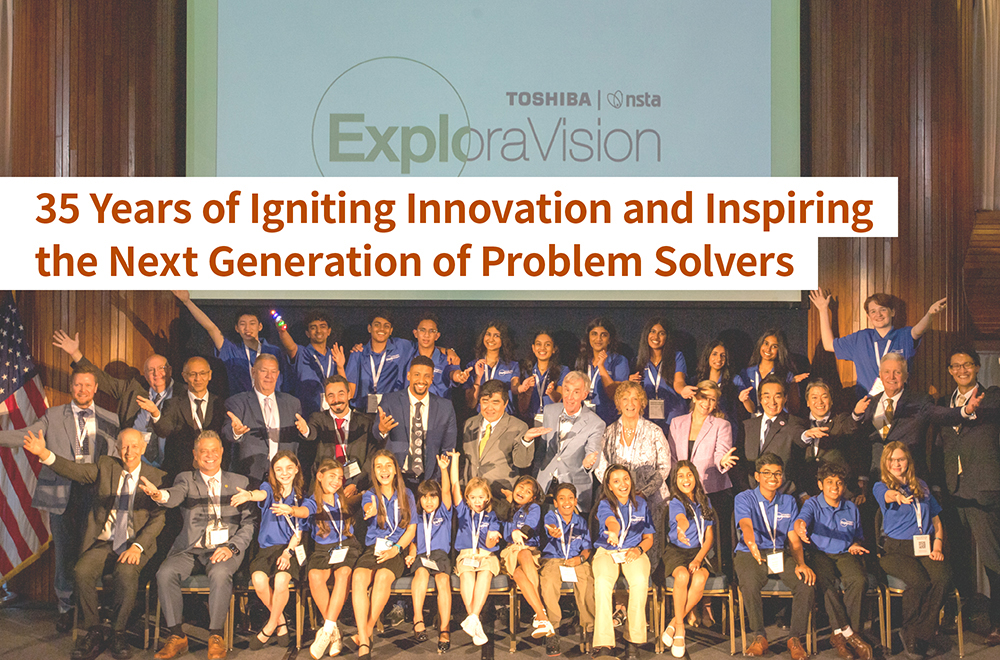
As ExploraVision enters its 35th year, the long-running Toshiba and National Science Teaching Association (NSTA) STEM competition continues to inspire students across the U.S. and Canada to imagine technologies that could improve the world. Since 1992, nearly 450,000 students have participated, developing not only innovative ideas but also the creativity, critical thinking, collaboration, and communication skills, nowadays increasingly needed for an AI-driven future. Through generations of student innovators, teachers, and families, ExploraVision has become a powerful example of Toshiba’s commitment to STEM education and its philosophy, “Committed to People, Committed to the Future.”
35 Years of Inspiring Future Innovators
When NSTA past President, Dr. Arthur Eisenkraft first co-founded the ExploraVision STEM competition between NSTA and Toshiba back in 1992, he didn’t expect people to still be talking about the program more than three decades later. NSTA is a leading organization for science educators in the U.S. and Canada and Toshiba’s partner in administering ExploraVision and other premier STEM education programs.
“At the time, I probably would have guessed that people would look back on it as an innovative program that lasted five years or so, inspired many students, and represented a wonderful collaboration among Toshiba, NSTA, educators, and schools,” the University of Massachusetts Boston distinguished professor said. “The fact that ExploraVision has continued for 35 years—and continues to engage new generations of students—is something I could never have anticipated.”
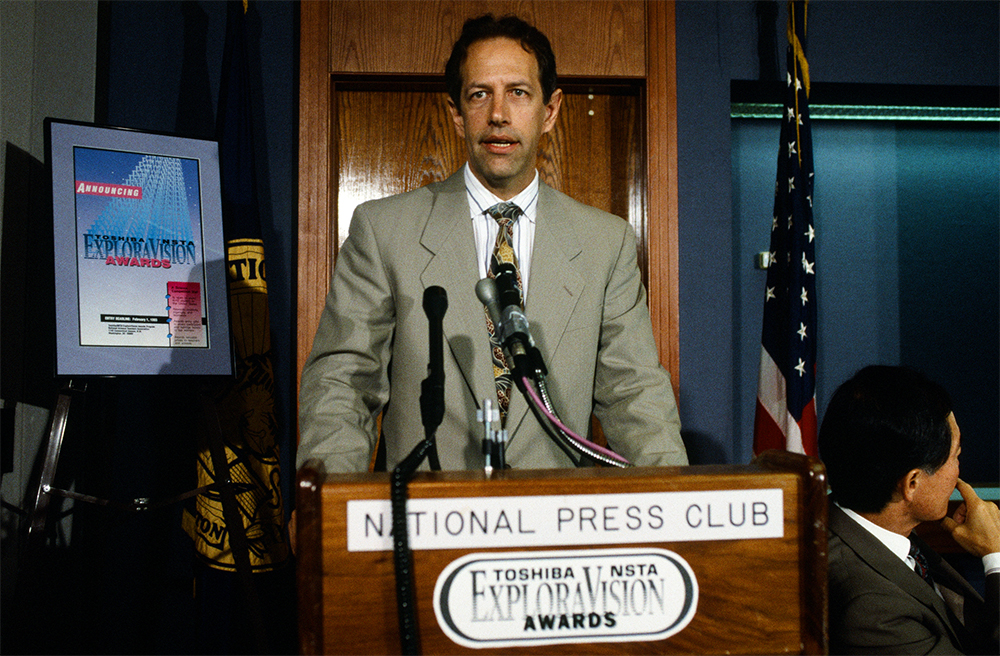
Toshiba/NSTA ExploraVision is a U.S. and Canadian competition that encourages students to imagine technologies that could improve the world while grounding their ideas in scientific thinking.
At a time when AI is rapidly reshaping society today, ExploraVision is helping young learners develop the critical thinking, communication, collaboration, and creativity skills needed not only to use AI effectively, but also to help shape the future.
ExploraVision hasn’t just survived for three and a half decades. It has thrived. And now, entering its 35th year, it’s stronger than ever.
Since its launch, ExploraVision has engaged nearly 450,000 students over 34 years, making it one of the world’s largest K-12 STEM competitions. During that time, nearly 27,000 schools have submitted more than 140,000 entries, and more than $13 million has been awarded in prizes and savings bonds.
But the program’s impact extends far beyond numbers.
Solving problems that affect people’s everyday lives
Student teams of two to four members compete in four grade-level categories: Primary (K-3), Upper Elementary (4-6), Middle School (7-9), and High School (10-12). Across six regions, top teams advance to the national competition, where four first-place and four second-place National Winner teams are ultimately selected.
In recent years, teams have submitted detailed ideas aiming to solve critical problems facing society today. Last year alone, winning projects brainstormed plans to try to use bacteria to reduce greenhouse gases, deploy AI drones to monitor wildfires, and create a micropatch that tracks the onset of dementia.
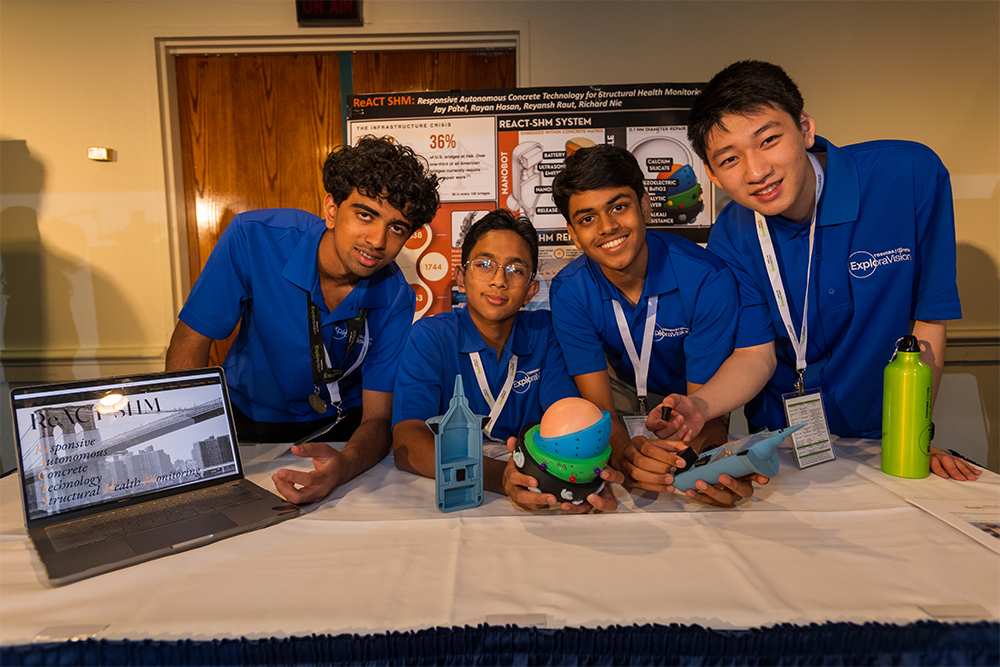
One project, submitted by a grade 10-12 team from Jericho High School on Long Island, N.Y., proposes a system that could detect and respond to damage inside concrete before it becomes a serious structural problem. Embedded sensors would monitor developing cracks, while nanoscale agents could deliver reinforcing materials to damaged areas.
The team said its goal was to connect damage detection with early repair, potentially making bridges, buildings, and other concrete structures safer and easier to maintain.
“We chose this topic because we share an interest in engineering and using science to solve problems that affect people’s everyday lives,” said Reyansh Raut, a student on the team. “People depend on bridges and buildings without necessarily thinking about the damage developing inside them. We were interested in whether these structures could detect and respond to that damage themselves. This gave us a chance to combine our interests in materials, technology, and problem solving around a practical challenge.”
Eisenkraft said he’d find it hard to pick out a favorite project over the past 34 years. But he did identify one that stood out—a “refrigerator of the future” imagined by students more than 30 years ago that turned out to be ahead of its time. As envisioned, the refrigerator would track when food items inside reached their expiration dates, suggest recipes based on the ingredients available, and even monitor what individual family members were eating. If someone reached for ice cream, for example, the fridge might suggest a carrot instead.
“Much of what they imagined sounded wildly futuristic at the time, but it’s remarkably familiar today,” he said. “What I remember most is that the students also thought about the unintended consequences of their invention. With all of the refrigerator’s new displays and controls, they worried that there would no longer be room on the refrigerator door for children’s artwork and report cards.
“That small observation captures something important about ExploraVision. We want students not only to ask, ‘What can technology do?’ but also, ‘How will this technology affect people’s lives?’”
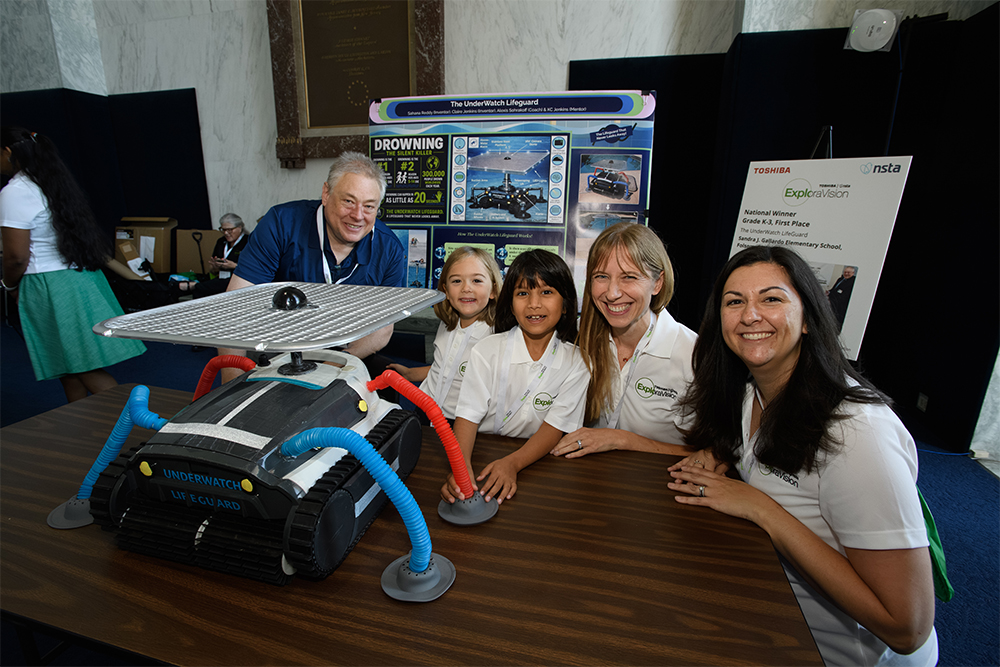
Of all the active supporters of the ExploraVision program, few have the perspective of Folsom, Calif.’s Alexis Sohrakoff. Thirty years ago, at age 10, Alexis and her two sisters won a second-place award for conceptualizing a “self-repairing road.” They envisioned a road with a liquid underlayer that would rise to fill any cracks or potholes, and solar units would also melt ice and snow.
Now Sohrakoff is participating in the ExploraVision program again, this time as a mom coaching her daughter and her daughter’s best friend. Their K-3 team won an award for devising an underwater robot that uses AI to recognize when someone is drowning and then rescues them by using a platform to raise them above the water.
In a video, Sohrakoff recalled feeling “very nervous” three decades ago, accepting her award at a national ExploraVision event.
“Now I’m back,” she said, “being nervous on behalf of my students.”
Demonstrating our philosophy through STEM education
In celebration of Toshiba America, Inc.’s 25th anniversary in 1990, TAI approached NSTA to express its desire to launch a STEM education-focused CSR initiative. This collaboration led to the launch of the Toshiba/NSTA ExploraVision program in 1992.
With roots tracing back to two founders who were themselves inventors and a legacy of innovation spanning more than 150 years, Toshiba has supported ExploraVision since the program’s inception. We see the program as a way to put Toshiba’s corporate philosophy, “Committed to People, Committed to the Future.,” into action, providing opportunities to think about future technologies and social challenges.
“Toshiba has supported the program for 35 years, so it’s something a lot of our employees are familiar with and really proud of,” said Eddie Temistokle, senior manager, corporate communications & CSR for Toshiba America Inc. “I think that becomes even stronger when employees get a chance to meet the students and see their projects. Their excitement is contagious, and you get to see firsthand what the program means to them. It makes you feel good knowing that Toshiba has played a part in giving these kids that opportunity.”
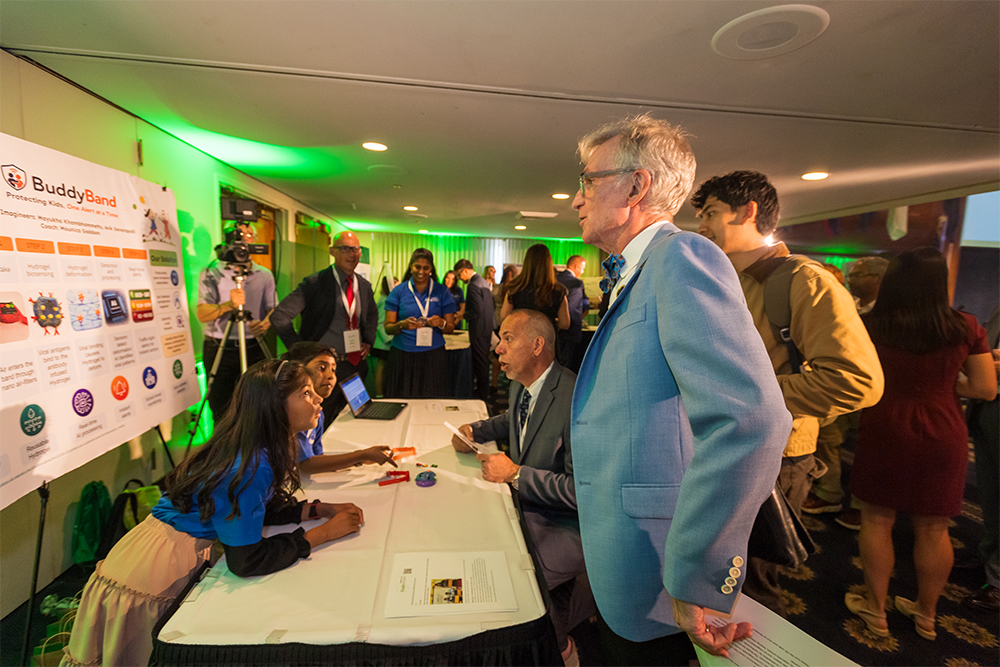
Eisenkraft describes Toshiba’s support as being critical to the program’s sustained success.
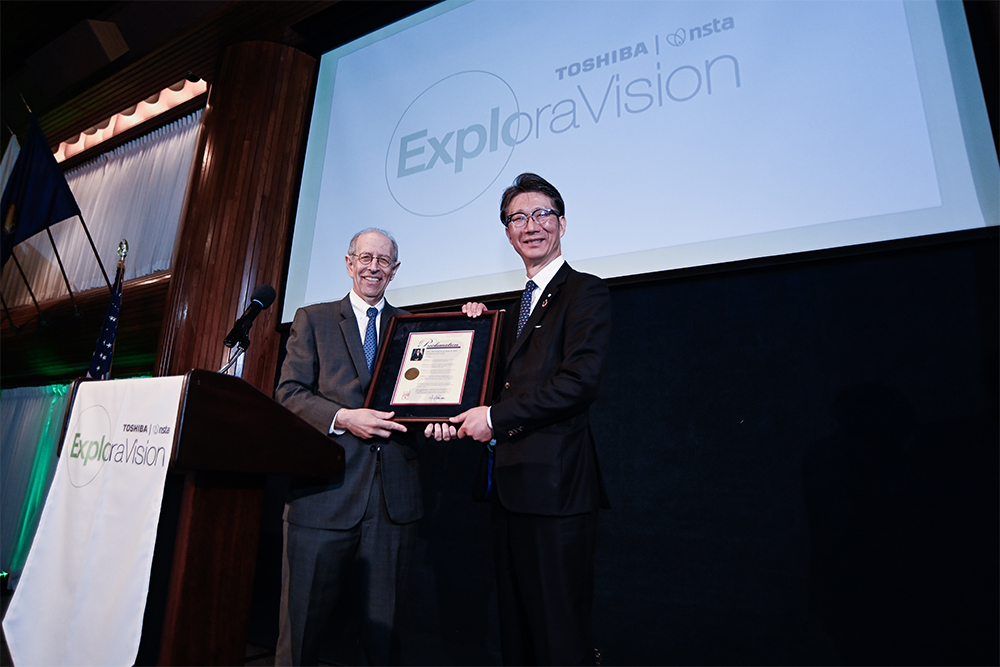
“Toshiba’s commitment to ExploraVision demonstrates what can happen when industry makes a sustained investment in students, teachers, and schools,” he said. “This has not been a short-term initiative. Toshiba has supported generations of young people in imagining themselves as inventors, researchers, problem solvers, and creators of the future.
“Thirty-five years of sustained support is extraordinary—and it is one of the major reasons ExploraVision has been able to reach and inspire so many students.”
Ready to inspire the next generation of innovators? Register your team or learn more at www.exploravision.org as we celebrate our 35th Anniversary Year
Photo credit Jax Photography
Related Links
*This section contains links to websites operated by companies and organizations other than Toshiba Corporation.
Toshiba, NSTA Kickoff 35th Annual ExploraVision Competition | Toshiba
Eight Student Teams Named National Winners of 34th Annual ExploraVision Competition | Toshiba
Related Contents

Share this article